
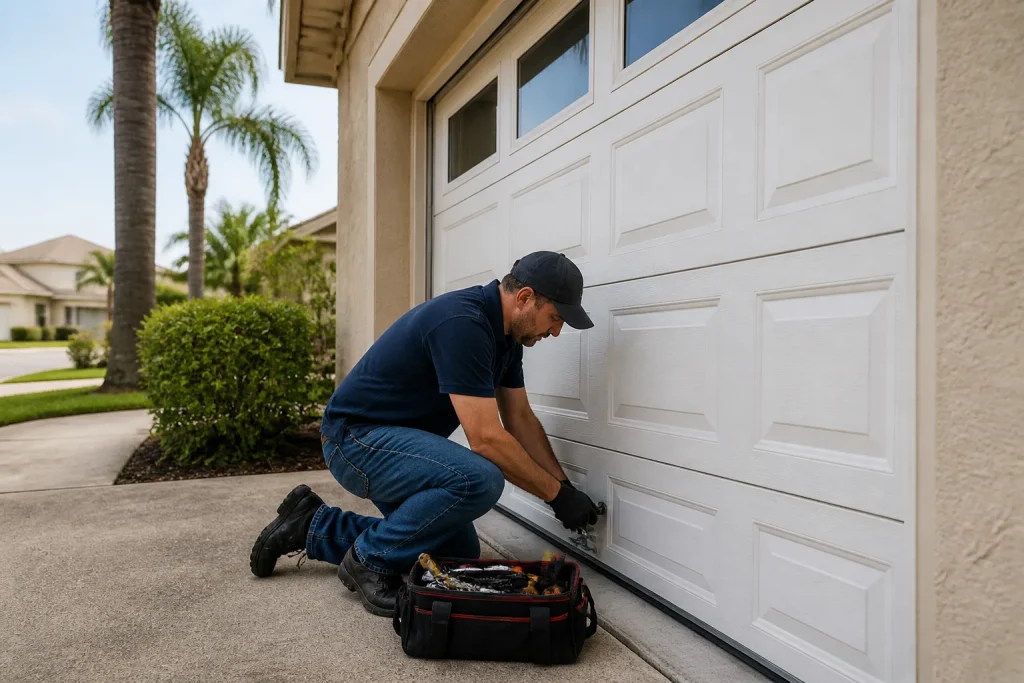
Genie Garage Door Repair in Texas City: A Homeowner’s Guide
If your Genie opener is blinking and your neighbor’s LiftMaster tip didn’t work, that’s not a coincidence. Genie’s diagnostic blink codes run on completely different logic than every other brand on the market, so advice borrowed from a different system can send you chasing the wrong part. Genie repair in Texas City usually comes down to decoding what the unit is actually telling you – and then fixing the model-specific fault, not a generic one.
If you’d rather not spend a Saturday on a ladder with a multimeter, call (844) 443-3807. We answer 24/7. Fast dispatch from 7am to 7pm, Sunday through Friday.
What Do Genie Blink Codes Actually Mean?
Genie blink codes are a flash-count diagnostic: the opener’s light or LED flashes a set number of times, pauses, and repeats. That count points to a specific fault category, and it does not map to the codes other manufacturers use. A pattern that means “safety sensor blocked” on one brand can mean something entirely different on a Genie. Counting the flashes before you call anyone saves real diagnostic time.
Here’s the general logic, and why it trips people up:
- Short flash counts usually point to sensor and safety-reverse problems – an obstruction, a misaligned photo-eye, or a wiring fault in the sensor circuit.
- Longer counts tend to point at travel limits, force settings, or the logic board itself.
- A steady or rhythmic blink with no door movement often means the board is getting power but not sending a command – a control-side issue, not a mechanical one.
The catch is that Genie has shipped many models over the years, and the exact meaning of each count varies by series. That’s why the number you count matters less than matching it to your specific model’s chart. We keep those charts on hand because guessing wastes everyone’s time. For homeowners in Texas City, the fastest path is to note the flash count, the model number on the head unit, and whether the door moves at all – then let a tech who knows Genie hardware take it from there.
Why Do Genie ProMax and SilentMax Units Fail in Texas City Humidity?
Genie’s ProMax and SilentMax lines have a known weak spot: the wiring harness and connector points are sensitive to persistent humidity. Texas City’s Gulf Coast air stays damp most of the year, and that moisture works its way into the opener housing, the logic board connectors, and the low-voltage sensor wiring. Over time, corrosion and connection resistance build up, and the opener starts behaving unpredictably.
Early warning signs worth watching for:
- The door opens fine but hesitates or reverses on the way down.
- Remotes and wall controls work intermittently, especially in humid stretches.
- The opener light flickers or dims when the motor runs.
- You hear the motor strain briefly before the door moves.
None of these mean the opener is finished. In many cases the fix is cleaning and reseating connectors, replacing a corroded sensor harness, or tightening a loose terminal – not swapping the whole unit. The mistake we see most is a homeowner replacing the opener when the real problem was a $12 wiring connection that had been quietly corroding for a year. If your Genie is acting up in Texas City humidity, garage door opener repair starts with the wiring and connections, not the motor.
Why Did My Genie Remote Stop Working After a Power Surge?
Intellicode remotes use rolling-code technology, which means the remote and the opener keep a synchronized changing code. A power surge or an extended outage can knock that synchronization out of step, and the remote stops being recognized even though nothing is physically broken. The unit isn’t dead – it just needs to be re-paired.
The good news: you usually don’t need a new remote. Re-syncing an Intellicode remote is a matter of putting the opener into programming mode and pressing the remote button so the two re-establish their code. Genie has used several programming sequences across model generations, so the exact button-hold pattern depends on your unit. A few practical notes:
- Clear any temporary code interference first – LED bulbs and nearby electronics can confuse the process.
- If one remote re-pairs but another won’t, the problem is that remote’s battery or its internal memory, not the opener.
- If no remote will re-pair after a surge, the receiver or logic board took the hit.
When re-syncing doesn’t take, that’s a sign the surge did real damage. A tech can test the receiver directly and tell you whether it’s a board-level fix or a remote replacement. It’s a common call in Texas City after summer storms roll through.
Can You Swap a Generic Spring Into a Genie System?
No – and this is where generic repair advice causes real trouble. Genie systems, like all torsion and extension spring setups, are sized to the specific door’s weight, track geometry, and drum configuration. Swapping in a spring chosen only by door weight ignores the system’s actual lift requirements, and the wrong spring will wear out fast, overload the opener, or fail outright.
Spring work is high-tension work, and it’s the one part of a garage door system we tell homeowners never to attempt themselves. A torsion spring under load stores enough energy to cause serious injury if it releases unexpectedly, and the winding process requires specific tools and technique. This is why spring repair is a dedicated specialty for us, not a line item on a general handyman’s list. On a Genie system, the spring has to match the door’s actual load and the drum and cable configuration, not just a weight chart. If your spring has snapped or your door feels suddenly heavy, stop operating it and get it looked at. You can read more about how we handle this in garage door spring repair.
Should You Replace the Genie Logic Board or Repair It?
Not always replace. Manufacturer support often defaults to “replace the logic board” because that’s the reliable fix from their side – a new board guarantees the problem is solved. But a tech who works on Genie systems regularly can often diagnose whether the fault is a single failed component, a bad relay, or a corroded connector, and repair the existing board instead of replacing it.
When repair is the better call:
- The board shows visible corrosion or a loose connection rather than a burned component.
- The fault is isolated to one function (say, the down-travel or the receiver) rather than the whole board.
- The opener is otherwise sound and the rest of the system checks out.
When replacement makes more sense: a burned board, multiple failed functions, or a unit old enough that the next failure is already on the horizon. The honest answer depends on what’s actually failed, and that’s a diagnosis call, not a guess. A tech who knows the Genie line can tell you which path saves you money. For a full look at what repair involves, see garage door repair.
When Should You Call a Pro?
Call a professional when the door won’t move at all, when a spring has visibly snapped, when the door is off its tracks, or when blink codes point to board or wiring faults you can’t safely trace. Also call if you’ve tried a re-sync and it didn’t work, or if the opener is straining under a door that suddenly feels heavy – that’s usually a spring problem, and it’s not a DIY job.
Our technicians have up to 9 years of experience and are factory-familiar with Genie systems, along with LiftMaster, Chamberlain, Clopay, Amarr, Wayne Dalton, Craftsman, and Raynor. That matters because Genie faults don’t behave like the others. We handle everything from a stuck remote to a full new door, so you’re not juggling contractors. Emergency service is a real offering for us, not a phrase – if you’re locked out or stuck, we answer 24/7 and dispatch from 7am to 7pm, Sunday through Friday. The price is quoted and agreed before any work starts, so there are no surprises on the invoice. Learn more about Texas City Garage Door Repair Pros.
Related services in Texas City: Genie opener repair, spring replacement, and full door installation all fall under one call.
The Bottom Line
Genie systems are reliable, but their diagnostics, wiring, remote pairing, and spring sizing are model-specific in ways generic advice won’t cover. Count the flashes, note the model, check the wiring before you replace the unit, and don’t touch the springs. If you’re in Texas City and need help, Texas City Garage Door Repair Pros offers free estimates – call (844) 443-3807.
Frequently Asked Questions
It depends on the fault – a remote re-sync and a logic board repair are very different jobs. We give a free estimate and set the price per job by written quote before any work starts, so you know the number before we begin. Call (844) 443-3807 for an exact quote – estimates are free.
Often, yes, for repair calls. We answer 24/7 and dispatch from 7am to 7pm, Sunday through Friday. A call outside dispatch hours is booked into the next opening. Call (844) 443-3807 to check availability.
No – the written estimate sets the price, and the price is agreed before work starts. If the diagnosis reveals a different fault than expected, we tell you before proceeding. Call (844) 443-3807 for a free estimate.
Yes. We work on legacy and current Genie systems, including Intellicode and ProMax units, and we can often repair an existing logic board rather than replace it. Call (844) 443-3807 to talk through your model.
If your Genie opener is blinking, hesitating, or refusing to respond in Texas City, don’t guess at the code or the part. Call (844) 443-3807. We answer 24/7. Fast dispatch from 7am to 7pm, Sunday through Friday. Free estimates, and the price is set before any work begins.
Written by the team at Texas City Garage Door Repair Pros.
Need Garage Door Help?
Call Texas City Garage Door Repair Pros - the local pro we connect you with is licensed and insured, here with fast help in Texas City.
(844) 443-3807